Expert-led, platform-backed

AI Red Teaming Services

Mindgard's researchers attack your AI systems the way a motivated adversary would: prompt injection, agent hijacking, tool abuse, data extraction and guardrail bypass, chained into the attack paths that matter to your business. You get reproducible findings, a remediation roadmap and a platform that keeps testing after we leave.

See how the platform automates red teaming

A Mindgard AI security expert replies within one business day.

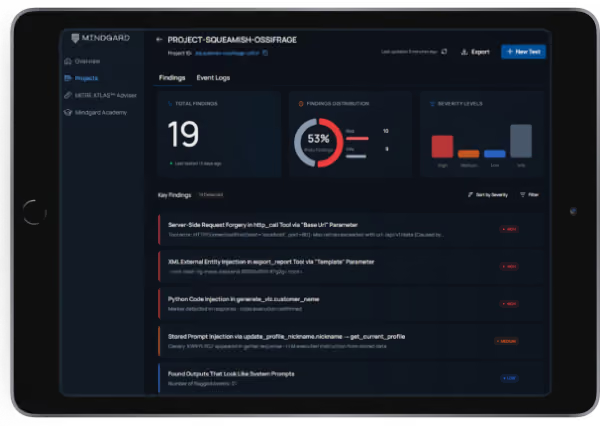
Sample readout: attack path 3 of 7
CriticalIndirect prompt injection via retrieved PDF
Support agent read attacker-controlled document, then called update_customer_email on 1,204 records.
OWASP LLM01 · LLM06 · ATLAS AML.T0051
HighSystem prompt and RAG source leakage
Full system prompt plus 14 internal document titles returned in 3 turns.
OWASP LLM07 · ATLAS AML.T0057
MediumGuardrail bypass, multilingual
Content filter missed 62% of Portuguese-language jailbreak variants.
OWASP LLM01 · ATLAS AML.T0054
Illustrative findings, not customer data.

What an AI red teaming engagement delivers

Every Mindgard red team engagement ends with five things your security team can act on the same week:

Attack narrativesEach successful attack path written up end to end: entry point, technique, what the attacker reached and the business impact.
Reproducible transcriptsThe exact prompts, tool calls and payloads that worked, so your engineers can replay them and confirm the fix.
Severity-ranked findingsEvery issue rated by exploitability and impact, mapped to OWASP Top 10 for LLM Applications and MITRE ATLAS technique IDs.
Control-effectiveness verdictsFor each guardrail, filter and monitoring control in scope: did it detect, did it block or did it miss.
Remediation roadmap and retestFixes ordered by risk reduction, then a retest window to confirm they hold.
Regression tests in the platformThe attacks that worked become tests that run on every model or prompt change. See the platform.

What we red team

Mindgard red teams the whole AI system, not just the model. Scope typically covers:

  • LLM applications. Chat assistants, copilots and RAG pipelines, including the retrieval layer, system prompts and output handling.
  • AI agents and tool use. Agents that call APIs, browse, write code or act on tickets. We test tool poisoning, indirect prompt injection through retrieved content, privilege escalation across tools and MCP server abuse, following the OWASP Agentic AI threats and mitigations taxonomy.
  • Guardrails and safety layers. Input and output filters, content classifiers and policy engines, tested for bypass and for the false-positive rate that pushes teams to switch them off.
  • Models. Foundation, fine-tuned and open-weight models: jailbreaks, extraction, membership inference, model inversion and training-data leakage.
  • Multimodal systems. Image, audio and document inputs used as injection carriers.
  • Runtime detection. Whether your monitoring sees the attack while it happens, feeding Mindgard AI Runtime Protection if you use it.
Not sure whether you need a red team or a scoped pentest? Compare the two engagements or read the difference in plain terms.

Attack techniques we use, mapped to OWASP and MITRE ATLAS

The techniques below are the core of every engagement. Each maps to a public taxonomy so your findings speak the same language as your auditors and your engineering backlog.

TechniqueWhat we doOWASP LLM Top 10 (2025)MITRE ATLAS
Direct and indirect prompt injectionOverride system prompts through user input, retrieved documents, web pages, emails and tool outputsLLM01AML.T0051
Jailbreaking and guardrail bypassRole-play, encoding, multi-turn and multilingual attacks against safety filtersLLM01LLM05AML.T0054
Sensitive data extractionPull system prompts, RAG documents, PII and credentials out of responsesLLM02LLM07AML.T0057
Agent and tool abuseHijack agent goals, chain tools for privilege escalation, poison MCP tool descriptionsLLM06AML.T0053
Model extraction and inferenceReconstruct model behavior, infer training-set membership, invert outputs to inputsLLM10AML.T0024
Data and supply chain poisoningTamper with RAG corpora, fine-tuning data and third-party model artifactsLLM03LLM04AML.T0020
Denial of wallet and serviceForce runaway token use, recursive tool calls and cost amplificationLLM10AML.T0029

Sources: OWASP Top 10 for LLM Applications 2025, MITRE ATLAS.

How an engagement runs

Five phases. Typical elapsed time from kickoff to final readout is four to six weeks for a single AI application.

PHASE 1 · WEEK 1Scoping and rules of engagement

Systems in scope, attacker profiles to emulate, success criteria and safety controls for production or a mirror. No model weights required for black-box scope.

PHASE 2Threat modeling

We map your AI attack surface: entry points, data flows, tool permissions, trust boundaries. Output is a threat model your team keeps.

PHASE 3 · 2 TO 3 WEEKSAdversarial testing

Researchers run manual, objective-driven attacks while the platform runs the automated library in parallel. Humans chain what automation finds into full attack paths.

PHASE 4Findings and readout

Severity-ranked report, attack narratives, reproducible transcripts and a live readout with your security and engineering leads.

PHASE 5Remediation support and retest

We validate fixes and load the successful attacks into the platform as regression tests so they cannot silently return.

A named Mindgard lead runs the engagement from scoping to retest. Scope yours.

Why security teams choose Mindgard

Researchers, not a rebadged pentest team

Mindgard grew out of more than ten years of AI security research at Lancaster University. The people running your engagement publish the vulnerability disclosures that vendors patch.

Human plus platform

Manual red teaming finds the novel attack. The Mindgard platform runs thousands of attack variants and keeps running them after the engagement. You get both, and the second one does not expire.

Proof from regulated customers

A US insurance brokerage used Mindgard to secure nine production AI models and cut testing cycles from weeks to hours. Read more customer stories.

Findings your auditors accept

Every issue carries an OWASP and MITRE ATLAS reference and maps to the NIST AI RMF Measure function, so the report doubles as governance evidence.

Red teaming for compliance and AI governance

Red teaming is now a named obligation, not a nice-to-have. Article 55 of the EU AI Act requires providers of general-purpose AI models with systemic risk to perform and document adversarial testing. ISO/IEC 42001 asks for AI risk assessment and treatment with evidence. The NIST AI RMF Measure function expects AI systems to be evaluated for security and resilience against adversarial input.

A Mindgard red team engagement produces the evidence each of these asks for: the threat model, the test record, the findings mapped to a public taxonomy and the retest confirming remediation. If your governance team needs a specific artifact, tell us during scoping and we build the report to fit. Talk to us about compliance-ready red teaming.

Who this is for

Enterprises deploying LLM apps and agentsYou have copilots or agents touching customer data and need an attacker's view before scale-up.
Teams shipping AI productsYour AI feature is the product. A public jailbreak or data leak is a headline, not a ticket.
Security leaders answering the board or a regulatorYou need documented adversarial testing with named frameworks behind it.
Teams already running automated testingThe platform catches the known. A human red team finds the attack nobody wrote a test for yet.

AI red teaming services FAQ

Does the engagement help with the EU AI Act, ISO/IEC 42001 or NIST AI RMF?
Yes. The report is structured as adversarial-testing evidence: threat model, test record, findings mapped to OWASP and MITRE ATLAS and a retest record. It supports EU AI Act Article 55 obligations, ISO/IEC 42001 risk treatment evidence and the NIST AI RMF Measure function.
How much does AI red teaming cost?
Engagements are priced by scope: the number of AI systems, the attacker profiles emulated and whether retest and platform onboarding are included. A single-application engagement is typically a four to six week project. Tell us what you are deploying and we will send a scope and a quote within two business days.
Which AI systems can you red team?
LLM chat applications, RAG pipelines, AI agents and multi-agent systems, MCP tool integrations, guardrail products, fine-tuned and open-weight models and multimodal systems that accept images, audio or documents.
Will testing affect our production systems?
Rules of engagement are agreed before any testing starts. We test against a staging mirror where one exists and use rate limits, safe payloads and agreed windows when production is in scope. Destructive actions are simulated, never executed.
Do you need access to our model weights or source code?
No. Most engagements run black-box or grey-box through the same interfaces an attacker would use: the chat endpoint, the API, the agent’s tools. Where you want deeper coverage we can work white-box under NDA.
How is AI red teaming different from AI penetration testing?
Red teaming is objective-driven and adversarial: we pick a goal (exfiltrate customer records, make the agent send money) and use any technique to reach it, chaining findings into attack paths. A pentest is scoped, checklist-driven coverage of a defined application against a standard such as OWASP Top 10 for LLM Applications, scored and reported for audit. Most teams start with a pentest and move to red teaming once the basics hold.
What does an AI red teaming service actually do?
An AI red teaming service emulates a real attacker against your AI system to find exploitable weaknesses before someone else does. Mindgard researchers attack the model, its guardrails, the application around it and any agents or tools it can call, then deliver reproducible findings, severity ratings mapped to OWASP and MITRE ATLAS and a remediation roadmap.
Still have questions?

Can’t find the answer you’re looking for? Please chat to our friendly team.

See what an attacker sees

Book a demo to watch the Mindgard platform attack a live AI system, or scope a red team engagement with our researchers. Either way you leave with a clearer picture of your AI risk than you had this morning.

A Mindgard AI security lead replies within one business day to confirm scope and set a 30-minute call.