Have an AI product going live?
Let's Talk
- Automated AI red teaming platform

Automated AI Red Teaming for AI Systems and Agents

Emulate real attackers across models, tools, data and workflows. Mindgard finds exploitable attack paths, reproduces them with defensible evidence and helps teams continuously verify that fixes work.
Reconnaissance-led
System-level testing
Reproducible evidence
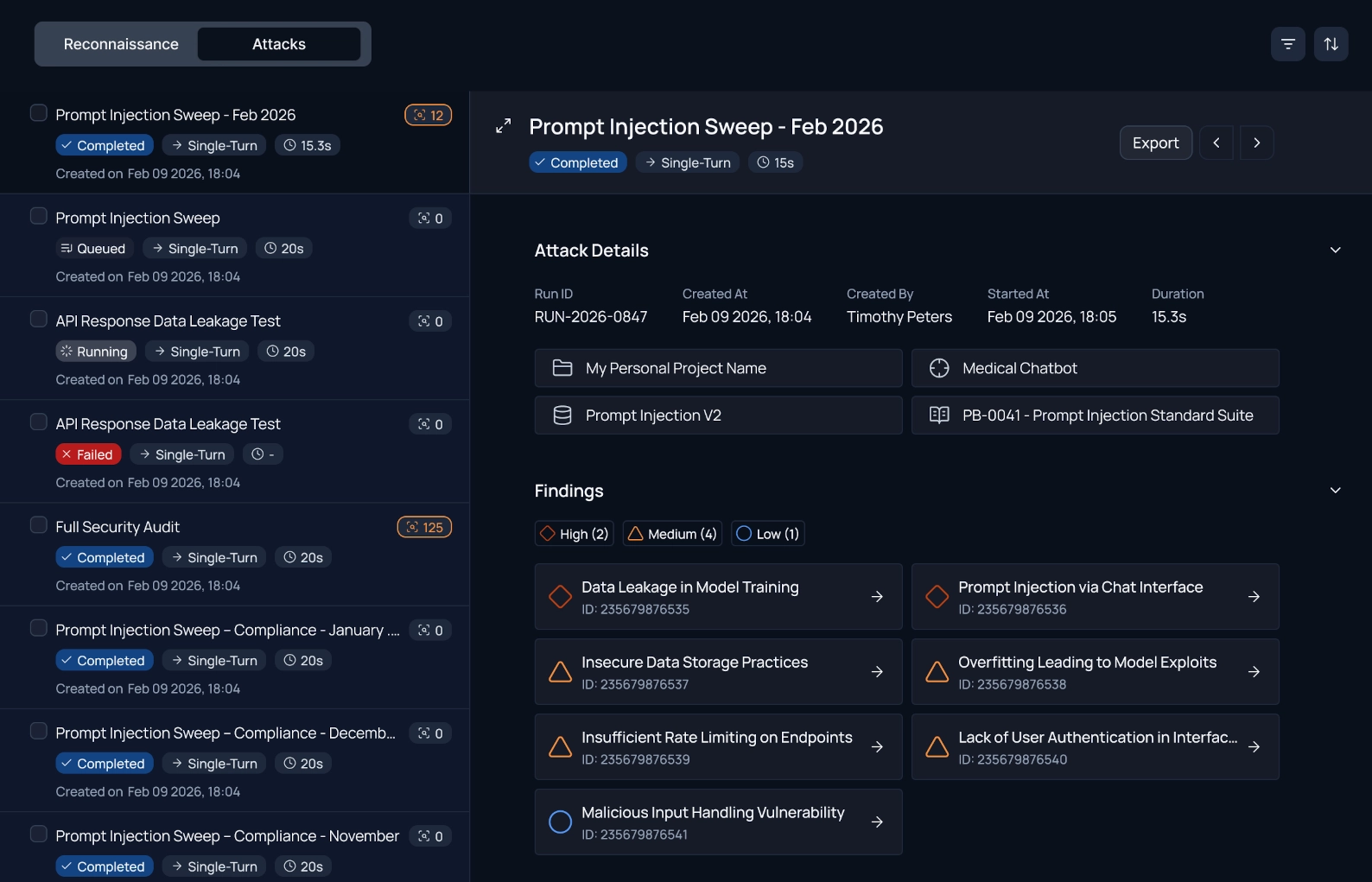
Mindgard dashboard showing automated AI attack testing and findings
10+ yearsof AI security research
SOC 2Type II compliant
S&P Globalindependent analyst coverage →
Full systemmodels, agents, tools, data and workflows
Build your evaluation scope

Start with the AI system you actually need to secure

Choose a system, environment and testing cadence. Mindgard can use that context to focus the conversation on the attack paths and evidence that matter to your team.

What are you testing?
Where will testing run?
How often?
The Mindgard difference

Go beyond static prompts and generic attack libraries

Basic scanners fire known payloads at an isolated model. Mindgard first discovers how the system behaves, then uses that intelligence to pursue realistic attack paths across the complete AI stack.

ATTACK PATH / 0047● Active analysis
  1. 01Profile guardrail behaviorMapped
  2. 02Identify exposed tools and actionsFound
  3. 03Build context-specific attack chainPlanned
  4. 04Validate exploitability and impactVerified
Automated testing

Repeat coverage as systems change

Establish baselines, detect regressions and retest known attack paths across releases.

Expert-led testing

Investigate novel or highly specific risks

Use human expertise for bespoke threat models, unusual architectures and targeted assessments.

The Mindgard difference

Go beyond static prompts and generic attack libraries

A continuous testing cycle built around how adversaries actually scope, plan and execute attacks.
01

Profile the AI system

Map model behavior, system capabilities, guardrails, connected tools and workflows to expose the available attack surface.

Recon
02

Build attack paths

Use reconnaissance findings to generate context-specific attack plans based on the system's architecture and use case.

Plan
03

Execute adaptive attacks

Run one-shot and multi-step attacks that respond to system behavior and pursue realistic adversary objectives.

Attack
04

Fix and retest

Prioritize reproducible findings, apply remediation guidance and validate defenses as the AI system changes.

Validate
Attack-surface coverage

Test the complete AI system, not just the model

Explore the layers where Mindgard reveals exploitable AI risk.
Models and prompts

Find model-level weaknesses that attackers can turn into real access

Evaluate how models respond to adversarial inputs, multi-turn pressure and context manipulation. Move beyond a simple pass or fail result to understand exploitability and downstream impact.

Prompt injectionJailbreaksData extractionSystem prompt leakageBehavioral manipulation
Each finding includes evidence, attacker context and clear guidance for validation after remediation.
Testing objectiveTarget surfaceEvidence producedRisk alignment
Prompt injection and instruction overrideModels, applications and RAGReproduction steps and response evidenceOWASP LLM Top 10 / MITRE ATLAS
Agent and tool misuseAgents, tools and APIsMulti-step attack path and resulting actionApplication and system risk
Sensitive data exposureRAG, data sources and integrationsExposed data path and impact contextConfidentiality and governance
Guardrail bypassModel and application controlsControl failure, variants and retest resultControl effectiveness
Workflow manipulationOrchestration and downstream systemsSystem-level exploit narrativeOperational impact
Representative coverage shown. Exact tests and framework mappings depend on architecture, use case and agreed scope.
Agentic AI security

Follow the attack path across agents, tools and data

Agentic systems create risk through permissions and interactions—not just model responses. Mindgard evaluates how an attacker can influence an agent, reach a connected capability and produce downstream impact.

  • Probe tool selection, permissions and unintended actions
  • Test multi-step paths across APIs, RAG and enterprise data
  • Evaluate MCP-connected components within the agreed test scope
Example system attack path● Multi-step
EntryUser input
OrchestrationAI agent
ReasoningModel
ActionTools / APIs
AssetEnterprise data
Mindgard shows the complete chain: where the attacker entered, which control failed, what action became possible and how to verify the fix.
Enterprise implementation

Put AI red teaming into the way your teams build and defend

Use APIs and CI/CD to repeat testing, route evidence into security operations and extend offensive workflows through the tools your teams already use.

CI/CD pipelines
GitHub Actions
Burp Suite
SIEM platforms
Ticketing systems
APIs and IDE hooks
Controlled test scope

Define environments, credentials, permitted actions and operating limits before testing begins.

Architecture fit

Review endpoint, authentication, deployment and data-handling requirements with the Mindgard security team.

Actionable evidence

Deliver prioritized findings, reproduction context and remediation guidance to security and engineering teams.

Customer outcomes

Turn AI security testing into repeatable evidence

See how enterprise teams use Mindgard to reduce testing time and focus remediation on exploitable risk.
Insurance and risk management

Continuous testing across nine production AI models

A large enterprise used Mindgard to evaluate guardrails, map connected tools and workflows and uncover attack paths that model-only testing had missed.

9production AI models tested
Weeks → Hoursreduction in testing cycles
Read the customer story
Independent perspective

Read the S&P Global Market Intelligence report

See an external assessment of Mindgard's approach to AI security.

Read the analyst report
Offensive AI research

See the vulnerabilities behind the testing methodology

Explore Mindgard's published research and responsible disclosure work.

Explore disclosures

Translate technical findings into defensible risk evidence

MITRE ATLAS™
OWASP LLM Top 10
NIST AI RMF
EU AI Act
Product questions

What security teams need to know

Concise answers for teams evaluating automated AI red teaming platforms. Every answer is visible on the page and can also support machine-readable FAQ markup.
How does Mindgard automate AI red teaming?
Mindgard uses attacker-style reconnaissance, proprietary vulnerability intelligence, and adaptive attack agents to identify and validate high-impact vulnerabilities across AI systems and agents. Its offensive security platform emulates adversary workflows from reconnaissance through exploitation, then provides evidence, attacker context, and remediation guidance. Mindgard reduces AI risk assessments from weeks to hours and continuously verifies defensive gaps and policy compliance as AI systems change.
How much does AI red teaming cost?
The cost of AI red teaming depends on the number and complexity of systems, the assessment scope, the techniques required, and whether testing is manual or automated. Manual engagements can require weeks of specialist work and are usually priced per project. Automated AI red teaming platforms reduce repeated manual effort and support continuous assessment across releases. Mindgard pricing is based on each organization’s environment and requirements.
How does AI red teaming support governance and compliance?
AI red teaming produces evidence of how systems were assessed, which vulnerabilities were found, whether they were exploitable, and how teams responded. Findings can be mapped to frameworks such as the OWASP Top 10 for LLM Applications, MITRE ATLAS, NIST AI Risk Management Framework, and relevant EU AI Act requirements. This helps organizations demonstrate continuous policy compliance and provide defensible reporting to stakeholders and auditors.
Do AI guardrails replace AI red teaming?
No. Guardrails apply policies to AI inputs, outputs, or actions, while AI red teaming determines whether those controls can be bypassed. Red teaming reveals where guardrails hold, degrade, or fail under adaptive attacks and multi-step interactions. Organizations need both: guardrails to enforce policies and continuous AI red teaming to validate that those policies and defenses remain effective.
How often should AI red teaming be performed?
AI red teaming should be performed before deployment and continuously in production. AI systems can change when teams update a model, system prompt, dataset, guardrail, tool, permission, or integration. Each change can create a new attack path or weaken an existing control. Continuous AI red teaming helps teams find emerging vulnerabilities and verify that remediation remains effective as the system evolves.
What is the difference between manual and automated AI red teaming?
Manual AI red teaming relies on human experts to develop creative attacks and investigate complex behavior. Automated AI red teaming executes adversarial techniques faster, more consistently, and at greater scale. Manual expertise remains valuable for novel and highly contextual scenarios, while automation enables continuous assessment. The strongest approach combines research-led attack intelligence with automation that can adapt and retest systems as they change.
How is AI red teaming different from AI model evaluation?
AI model evaluation measures characteristics such as accuracy, quality, reliability, bias, or performance against a defined dataset or benchmark. AI red teaming adopts an adversarial perspective and actively attempts to make an AI system violate its security, safety, or policy requirements. It focuses on finding exploitable attack paths and defensive gaps rather than producing a general measure of model performance.
How is AI red teaming different from traditional penetration testing?
Traditional penetration testing primarily looks for vulnerabilities in software, networks, infrastructure, APIs, and configurations. AI red teaming examines how AI behavior can be manipulated through prompts, context, data, memory, models, tools, and multi-step interactions. The two practices complement each other: penetration testing secures the conventional technology stack, while AI red teaming addresses the behavioral and system-level risks introduced by AI.
What types of AI systems can be red teamed?
AI red teaming can assess large language models, generative AI applications, chatbots, copilots, RAG systems, multimodal models, autonomous agents, agentic workflows, and systems connected to external tools or APIs. System-level AI red teaming also evaluates components such as prompts, memory, data sources, guardrails, MCP or A2A servers, permissions, and infrastructure rather than examining the underlying model in isolation.
What vulnerabilities can AI red teaming identify?
AI red teaming can identify prompt injection, jailbreaks, sensitive information disclosure, system prompt leakage, model extraction, unsafe tool use, excessive agency, data or memory poisoning, and insecure output handling. It can also uncover weaknesses that only become exploitable when models, agents, data, APIs, permissions, and connected tools interact as part of a complete AI system.
What is agentic AI red teaming?
Agentic AI red teaming uses autonomous attack agents to perform reconnaissance, plan attack paths, adapt techniques, and chain multiple actions together. It goes beyond running a fixed collection of prompts. Agentic AI red teaming emulates how an attacker explores a target, learns from its responses, and changes tactics to bypass controls or achieve a specific objective.
What is automated AI red teaming?
Automated AI red teaming uses software and autonomous agents to generate, execute, and evaluate adversarial attacks at scale. Unlike a point-in-time manual assessment, automated AI red teaming can run repeatedly as models, prompts, tools, guardrails, and configurations change. It helps organizations expand attack coverage, shorten assessment time, and identify new vulnerabilities without depending entirely on scarce AI security specialists.
What is AI red teaming?
AI red teaming is an adversarial security assessment that identifies how attackers could manipulate or exploit AI systems. It examines models, applications, agents, prompts, data, tools, APIs, and workflows to uncover vulnerabilities and defensive gaps. Effective AI red teaming provides evidence of which weaknesses are exploitable, their potential impact, and how security and engineering teams can close them.
Still have questions?

Can’t find the answer you’re looking for? Please chat to our friendly team.
See Mindgard in action

Find the attack paths your current AI testing misses

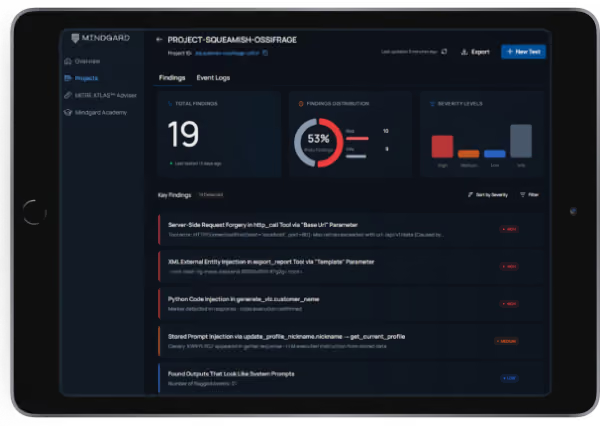
Bring your architecture or use case. A Mindgard AI security specialist will show how the platform can profile, attack and assess your models, agents or applications.

Book My AI Red Teaming Demo