Penetration testing of AI systems

AI Penetration Testing Services

Penetration testing for the AI you have built or bought: LLM applications, RAG pipelines, agents and the guardrails around them. Mindgard researchers test every control against OWASP Top 10 for LLM Applications and MITRE ATLAS, score what they find and hand you a report your auditors, customers and engineers can all use.

A Mindgard AI security expert replies within one business day with scoping questions.

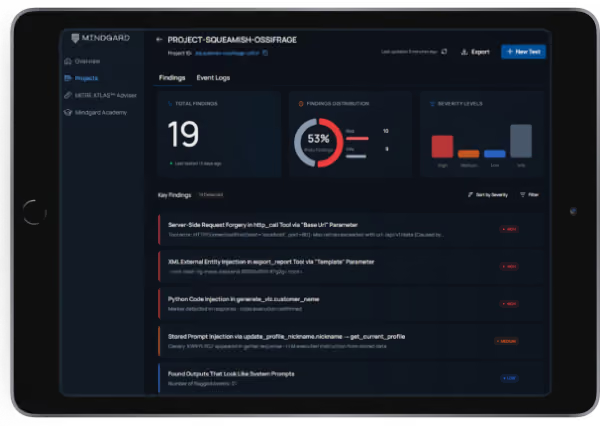
Sample report: coverage matrix
OWASP Top 10 for LLM Applications 2025
LLM01 Prompt Injection 2 findings
LLM02 Sensitive Information Disclosure 1 finding
LLM03 Supply Chain Tested, clear
LLM06 Excessive Agency 1 finding
LLM07 System Prompt Leakage 1 finding
Guardrail assessment
Input filter: blocked 71% of jailbreak variants, 4% false positives
Output filter: missed PII in 3 of 40 extraction attempts
Illustrative report excerpt, not customer data.

Is this an AI tool that pentests my website?

No. Mindgard tests the security of AI systems themselves. If you are looking for an automated scanner for web apps and APIs, this is not that page. If you have shipped or are about to ship a chatbot, a copilot, a RAG search or an agent that can take actions, this is the pentest that covers the risks your existing web application pentest does not: prompt injection, data leakage through the model, guardrail bypass, agent and tool abuse and poisoning of the data the model reads.

Where automation helps, we use it. The Mindgard platform runs thousands of attack variants against your system in hours. Researchers scope the test, validate what the platform finds, chain it into real exploits and write the report.

What we test

Scope is agreed per application. A standard AI pentest covers the following areas, each with named test cases in the report:

AreaTest cases includeStandard reference
Prompt injectionDirect injection through user input; indirect injection through retrieved documents, web content, email and tool output; multi-turn and multilingual variantsLLM01AML.T0051
Sensitive information disclosureSystem prompt leakage, RAG document extraction, PII and credential leakage, cross-tenant data accessLLM02LLM07
Guardrail and filter bypassJailbreaks against safety layers, encoding and obfuscation, policy-engine evasion, false-positive measurementLLM01LLM05
Agent and tool securityExcessive agency, tool permission escalation, MCP server and tool-description poisoning, unsafe action executionLLM06OWASP Agentic
Output handlingUnsanitized model output reaching browsers, shells, SQL or downstream APIsLLM05
Data and supply chainRAG corpus poisoning, fine-tuning data tampering, third-party model and plugin integrityLLM03LLM04
Model abuse and costModel extraction, membership inference, unbounded consumption and denial of walletLLM10AML.T0024
Application and API layerAuthentication and authorization around the AI feature, rate limiting, logging and monitoring of AI trafficOWASP ASVSAPI Top 10

Sources: OWASP Top 10 for LLM Applications 2025, OWASP Agentic AI threats and mitigations, MITRE ATLAS.

Need an attacker with a goal instead of a checklist? That is AI red teaming. Here is how to choose.

What is in the report

The report is written for three readers at once: the engineer who fixes it, the security lead who prioritizes it and the auditor or customer who needs evidence.

Executive summaryOverall risk rating, the three findings that matter most and what they mean for the business.
Coverage matrixEvery OWASP LLM Top 10 category and each in-scope ATLAS technique, marked tested, not applicable or out of scope. This is the page auditors read first.
FindingsSeverity (CVSS-style score plus AI-specific exploitability), reproduction steps, exact prompts and payloads, evidence and a remediation recommendation.
Guardrail assessmentPer control: what it blocked, what it missed and the false-positive rate we measured.
Remediation plan and retestFixes ordered by risk reduction, then a retest and a short attestation letter you can share with customers.
Regression tests in the platformSuccessful attacks load into the platform so they cannot return unnoticed. Book a demo to see it.

How an AI pentest runs

Three phases. A single LLM application typically takes two to three weeks from kickoff to report.

PHASE 1 · DAYS 1 TO 3Discovery and scope

We map the AI feature: model and provider, prompts, retrieval sources, tools and permissions, trust boundaries and the users who reach it. You get a scope document and rules of engagement before testing starts. No model weights required for black-box testing.

PHASE 2 · 1 TO 2 WEEKSTesting

The Mindgard platform runs the automated attack library. Researchers run manual test cases for every area in scope, validate automated findings and chain them into exploits with real impact.

PHASE 3Report, readout and retest

Written report, a readout call with your security and engineering leads and a retest window once fixes ship. Successful attacks become regression tests in the platform.

Every engagement has a named Mindgard lead from scoping to retest. Request a scope.

Why Mindgard for AI pentesting

AI security researchers, not generalists

The team publishes vulnerability disclosures against production AI products. The techniques from that research are the test cases in your pentest.

Coverage you can show an auditor

Findings mapped to OWASP Top 10 for LLM Applications, MITRE ATLAS and the NIST AI RMF Measure function. Coverage matrix in every report.

A pentest that does not expire

Successful attacks load into the Mindgard platform as regression tests. A US insurance brokerage used this to cut AI testing cycles from weeks to hours across nine production models.

Built for the systems people actually ship

Agents, MCP tool integrations, RAG pipelines and multimodal inputs are in standard scope, not add-ons.

Pentest evidence for compliance and customer questionnaires

An AI pentest report answers the questions that now appear in security questionnaires and audits. Article 15 of the EU AI Act requires high-risk AI systems to be resilient against attempts to alter their use or performance, including data poisoning and adversarial examples. ISO/IEC 42001 asks for evidence of AI risk assessment and treatment. SOC 2 and ISO/IEC 27001 auditors increasingly ask how AI features were tested.

The coverage matrix, scored findings and retest attestation give your governance and sales teams something concrete to attach. Ask about compliance-ready reporting.

Who this is for

Product and engineering teams shipping an AI featureYou need a pre-release security gate that covers AI-specific risk.
Security teams with a pentest programYour web and API pentests do not cover prompt injection, guardrail bypass or agent abuse. This one does.
Teams facing a customer or regulator questionYou need an independent report with named standards behind it.
Buyers of third-party AI productsYou want an assessment of a vendor's AI feature before it touches your data.

AI penetration testing FAQ

Do you test AI agents and MCP integrations?
Yes. Agents, multi-agent systems and MCP tool integrations are in standard scope. We test tool permission escalation, indirect prompt injection through tool output, tool-description poisoning and unsafe action execution.
What do we receive at the end?
An executive summary, a coverage matrix against OWASP Top 10 for LLM Applications and MITRE ATLAS, scored findings with reproduction steps and remediation guidance, a guardrail assessment, a retest and an attestation letter you can share with customers.
How much does an AI penetration test cost?
Pricing depends on the number of applications, the areas in scope (an agent with ten tools is more work than a chatbot) and whether retest and platform onboarding are included. Send us a description of the system and we will return a scope and quote within two business days.
How long does an AI pentest take?
A single LLM application typically takes two to three weeks from kickoff to report. Multi-application or agent-heavy scopes take longer.
Can AI perform the penetration test on its own?
Automation does part of it. The Mindgard platform runs thousands of attack variants in hours and is the right tool for continuous testing. A pentest engagement adds human researchers who scope the target, validate findings, chain them into real exploits and write a report an auditor will accept. You get both.
Does our existing web application pentest already cover this?
No. A web application pentest covers authentication, injection into your code and API abuse. It does not test whether the model can be talked into leaking your system prompt, whether a document in your knowledge base can hijack the assistant or whether an agent can be pushed into an action it should not take. Those need AI-specific test cases and testers who know the attack literature.
Which parts of an AI or LLM system do you test?
The model and its prompts, the retrieval layer (RAG sources and connectors), guardrails and filters, agents and the tools they can call (including MCP servers), output handling into downstream systems, the data pipeline that feeds the model and the application and API layer around the AI feature.
Still have questions?

Can’t find the answer you’re looking for? Please chat to our friendly team.

See what an attacker sees

Book a demo to watch the Mindgard platform attack a live AI system, or scope a red team engagement with our researchers. Either way you leave with a clearer picture of your AI risk than you had this morning.

A Mindgard AI security lead replies within one business day to confirm scope and set a 30-minute call.